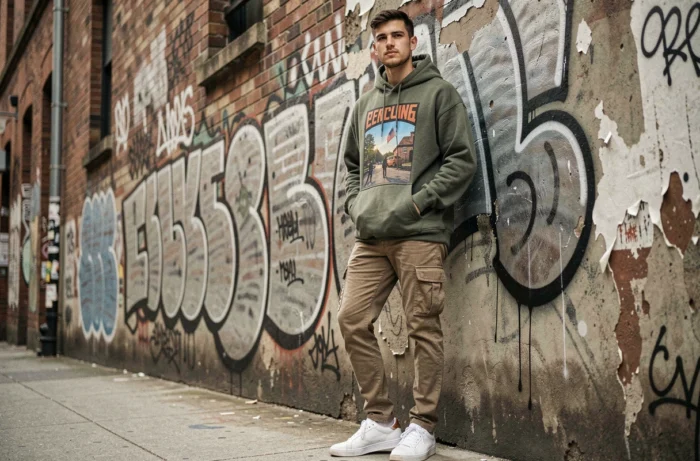
Urban fashion refers to a set of clothing codes born in the street, at the crossroads of hip-hop, skateboarding, and graphic cultures. It includes pieces like hoodies, sneakers, cargo pants, and oversized t-shirts, worn in a relaxed yet polished manner. For several seasons now, this wardrobe has established itself well beyond its original audience, reaching the runways and collections of major fashion houses.
European textile regulation and urban fashion: what changes in 2026
Streetwear brands that operate through limited drops and capsule collections are facing a recent regulatory constraint. Since July 19, 2026, large textile companies operating in the European Union can no longer destroy unsold new clothing, accessories, or shoes. They must prioritize donation, destocking, refurbishment, or recycling.
This ban stems from the Regulation (EU) 2024/1781 on the ecodesign of sustainable products (ESPR), which came into effect in July 2024. The text extends sustainability requirements to almost all physical products, including textiles.
For urban fashion, the consequence is direct. The model of artificial “sold out,” where a brand overproduces and then discards unsold items, becomes legally risky. Streetwear labels must now calibrate their production volumes more precisely or organize second-life pathways for unsold items. Several specialized players document these regulatory changes and their impact on brands, as can be seen on https://www.lefumoirdelamode.com/, which closely follows industry news.

Textile digital passport: traceability of urban clothing
Another mechanism is arriving in the wake of the ESPR: the digital passport for textile products. This system stipulates that a garment will be associated with a scannable medium (QR code or NFC chip) providing access to its manufacturing data, exact composition, and environmental footprint.
For a hoodie or a pair of sneakers sold as “eco-friendly,” the digital passport will make verifiable what was previously solely the brand’s claim. The composition of fibers, the country of manufacture, the chemical treatments applied: all this information will be accessible to the consumer at the time of purchase.
End of greenwashing in streetwear
This passport is linked to a parallel tightening of rules on environmental claims. Vague mentions (“eco-friendly,” “responsible collection,” “sustainable fashion”) without verifiable proof are in the sights of European regulators. Urban fashion brands that rely on an ethical positioning will need to document every assertion.
The streetwear sector, which has multiplied “green” capsules in recent years, will have to balance between a genuine commitment to quality in manufacturing and a mere marketing argument. The difference will be visible, black on white, through the digital passport.
Urban pieces and silhouettes that structure the current trend
Beyond the regulatory framework, urban fashion is defined by a recognizable wardrobe. Certain pieces consistently appear in collections, season after season, with variations in cut and material.
- The oversized hoodie, often made of heavy cotton, worn alone or layered under a technical jacket. Its loose fit remains the most recognizable marker of urban style.
- The cargo pants with patch pockets, making a strong comeback after several seasons of absence, available in lighter fabrics than the original military cotton.
- The thick-soled sneaker, which has become a cross-cutting classic adopted by both streetwear enthusiasts and followers of a more chic casual style.
- The graphic t-shirt with screen-printed designs, inherited from skate culture and graffiti, which serves as a medium for visual expression.
These pieces combine in a layering logic rather than strict matching. The principle is to mix loose volumes on top with more fitted cuts on the bottom, or vice versa. This approach gives urban style its flexibility: it adapts to morphology and context without imposing rigid rules.

Textile production and responsible manufacturing: the challenge for urban brands
Urban fashion shares with the rest of the textile industry a structural problem of overproduction. Frequent drops, which create perceived scarcity, also generate production volumes that are difficult to absorb when demand does not follow.
The commitment to local or European manufacturing is one of the responses adopted by some brands. Producing in France or in European workshops reduces logistical delays and allows for shorter runs, better aligned with actual demand. The higher production costs are offset by the reduction of unsold items and by an assumed quality positioning.
Materials and durability of streetwear clothing
The choice of materials directly influences the longevity of an urban piece. A hoodie made of organic cotton with a dense weight will last several seasons. A low-quality synthetic fiber equivalent will lose its shape after a few washes.
Consumers attentive to urban fashion are increasingly checking the composition before purchase. The quality of the textile is becoming a selection criterion on par with design. This demand pushes brands to communicate about their suppliers and dyeing processes, especially in a context where the digital passport will make this data accessible.
- Certified organic cotton, favored for t-shirts and hoodies, offers better wear resistance than conventionally treated cotton.
- Recycled polyester, used for technical jackets and some accessories, reduces dependence on virgin fibers derived from petroleum.
- European linen, rarer in streetwear but present in the autumn collections of some brands, provides a texture and breathability different from cotton.
Urban fashion is no longer just a matter of style and seasonal trends. European regulatory constraints, from the digital passport to the ban on destroying unsold items, are reshaping the conditions under which a brand can produce and sell. The labels that will survive this shift are those that align their production with realistic volumes and traceable materials, not those that have multiplied “responsible” capsules without proof to back them up.