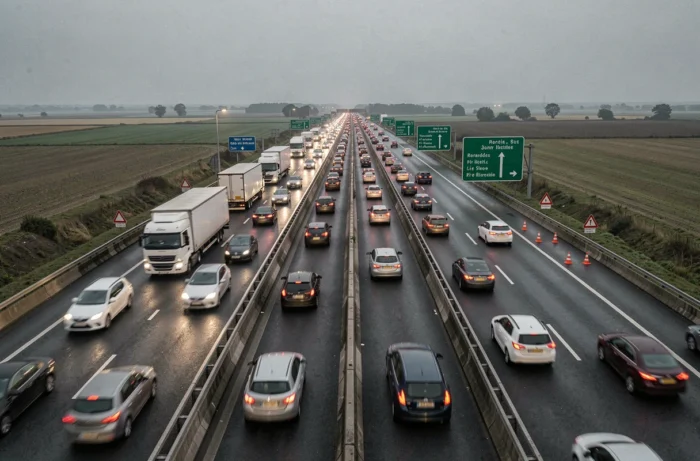
The A4 motorway, which connects Paris to Strasbourg via Reims and Metz, records the highest volume of accidents in the French motorway network. According to the National Interministerial Observatory for Road Safety (ONISR), this route accounts for about six accidents per week. This figure is explained less by the quality of the road than by what happens there on a daily basis.
Why the number of accidents on the motorway is rising again
Before focusing on a particular route, a general observation must be made. Mortality on French motorways surged by 26% in 2025, after several years of decline. The 2026 barometers from ONISR confirm that this trend has not yet reversed.
When measured per kilometer traveled, the motorway network remains statistically the safest in France. However, this average masks considerable disparities between routes.
Some sections, saturated with traffic or subject to particular configurations, concentrate a disproportionate number of serious accidents. When identifying the most dangerous motorway in France, it is precisely this type of imbalance that is highlighted.

A4 Paris-Strasbourg: traffic that generates risk
The A4 is a strategic route for exchanges with Germany and Central Europe. Every day, hundreds of thousands of vehicles use it. This volume of traffic alone creates the conditions for danger.
Heavy trucks, traffic jams, and the accordion effect
The high proportion of heavy trucks on this route alters the flow of traffic. The speed differences between trucks and cars cause chain braking. In case of slowdowns, the accordion effect surprises the least attentive drivers.
Rear-end collisions in traffic jams are a characteristic type of accident on the A4. A vehicle traveling at normal speed collides with another that is almost stationary. The violence of the impact is all the greater if the driver has not anticipated the slowdown.
Construction zones and lane reductions
The A4 is frequently under construction on certain sections, particularly in Île-de-France and Lorraine. These areas reduce the number of available lanes and create bottlenecks. Inadequate speed in construction zones remains one of the most documented accident factors by Road Safety.
Drowsiness and fatigue: the real dangers of long motorway journeys
Rankings of dangerous roads often emphasize the physical configuration of the roadway (curves, slopes, lack of central divider). On the motorway, the problem is different. The road is well-marked, well-maintained, but the driver lets their guard down.
Drowsiness at the wheel is overrepresented in fatal accidents on the motorway. The monotony of the journey, long straight stretches, and the comfort of the vehicle dull vigilance. A micro-sleep of four seconds at 130 km/h means over 140 meters traveled blindly.
Professional data published in 2025 and 2026 confirm another worrying phenomenon: nearly two-thirds of serious collisions involving motorway agents occur on the emergency stop lane or the right lane. In other words, vehicles stopped at the roadside are particularly exposed.
- Fatigue and drowsiness are the primary causes identified on long motorway journeys, ahead of alcohol and speed
- Accidents in the emergency stop lane affect both stranded motorists and intervention agents, over a hundred of whom were involved in accidents in 2025
- Inadequate speed in case of traffic jams or construction is a recurring aggravating factor, especially on high-traffic routes like the A4

Dangerous motorway in France: beyond the ranking, the right reflexes
Knowing the most accident-prone route is only useful if it changes behaviors. Why do some drivers stop every two hours while others drive for five hours without a break? The answer often lies in a poor estimation of their own fatigue.
Taking a twenty-minute break every two hours significantly reduces the risk of accidents related to drowsiness. This advice, repeated every summer by prevention campaigns, remains too little applied during major departures.
Adapting driving to risk areas
On a route like the A4, some sections are more dangerous than others. The approaches to Reims and Metz, where traffic densifies, deserve increased attention. In construction zones, reducing speed is not a suggestion: it corresponds to a real and immediate danger.
Maintaining a safe distance of at least two seconds from the vehicle ahead remains the most effective measure to avoid chain collisions. On a wet motorway, this distance should double.
The A4 motorway is not dangerous by design. It concentrates accidents because it concentrates traffic, heavy trucks, and long journeys. The French motorway network has recently seen a deterioration in its safety figures, with a marked increase in mortality in 2025 continuing into 2026.