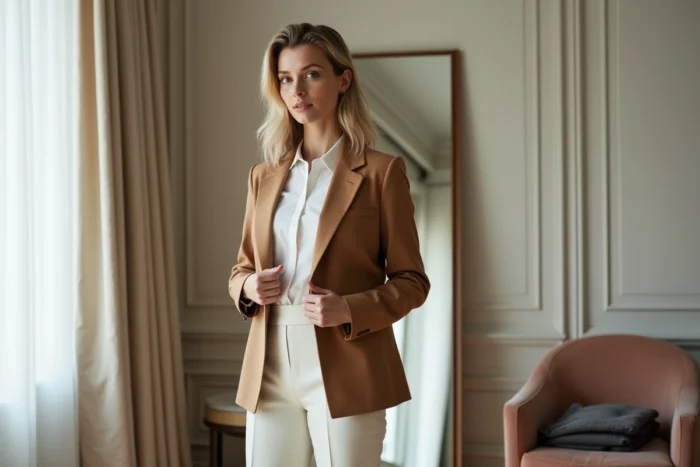
We’ve all experienced that moment in front of the mirror where the outfit looked fine on the hanger, but falls flat once worn. The cause often lies in a poorly matched texture, a cut that doesn’t follow the body’s line, or an accessory that’s too much (or too little). Elevating your style on a daily basis relies on concrete reflexes and a few visual composition principles that can be applied every morning.
Warm neutral palette: the foundation that simplifies the entire wardrobe
When you open your closet in the morning with ten minutes to spare, the last thing you need is to juggle pieces that don’t go together. The fall-winter 2026 trends confirm a well-established movement: building your wardrobe around two or three warm neutrals (browns, anthracite, cherry mocha, near-black) so that each combination works almost automatically.
It’s beneficial to replace impulsive colorful purchases with a simple test. Before adding a piece, check that it pairs with at least three other items already in the wardrobe. If it doesn’t, it will end up forgotten on a hanger. This discipline changes your daily look more than a statement piece worn once per season.
By following fashion on Belle et Élégante, you quickly notice that this logic of seasonal palettes is found in the most current selections, with close tone combinations that create an impression of effortless sophistication.
Textures and finishes: what distinguishes a flat outfit from a constructed look
The question of materials weighs as heavily as colors or body shape in the perception of style on a daily basis. A raw denim worn with a thick knit sweater tells a different story than with a fine poplin blouse, even if the palette remains the same.
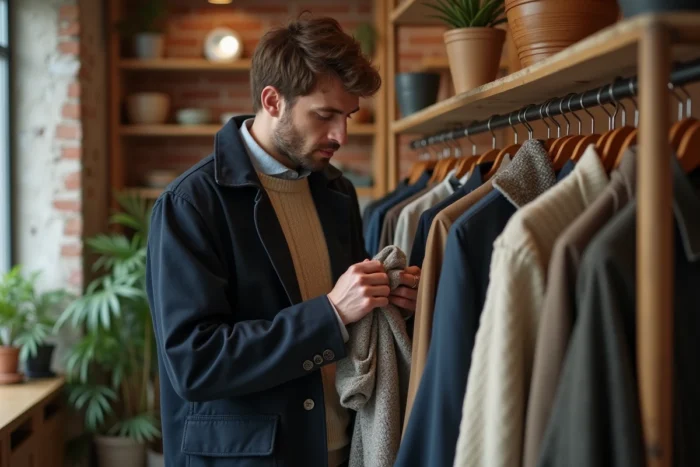
Mixing two contrasting textures in an outfit is enough to create visual depth. This principle works on all budgets. For example: pairing a matte material (brushed cotton, washed linen) with a slightly shiny or structured material (leather, satin, ribbed knit). The contrast draws the eye without making the outfit appear overloaded.
Opinions vary on this point, but it is often observed that a garment made from natural materials (wool, dense cotton, linen) ages better and drapes better after a few washes than a synthetic equivalent. Over time, the quality of the fiber directly affects the overall appearance.
Finishes to check before buying
- Inner seams: clean and even stitching indicates careful construction, even on accessible brands
- The fit of the collar and cuffs: these are the areas that deform first and reveal a tired garment
- Buttons and closures: a mother-of-pearl or brushed metal button changes the perception of a basic shirt without significantly altering the price
Accessories and jewelry: the ratio to maintain to avoid overload
Accessories can enhance an outfit as much as they can unbalance it. An excess of jewelry or a bag that clashes with the shoes creates the opposite effect of what is desired. The daily problem is that we accumulate by habit without perspective.
The operational rule: choose a single focal point per outfit. If wearing statement earrings, lighten the neck and wrists. If the bag is structured and colorful, keep the jewelry discreet. This principle of visual hierarchy avoids overload without requiring prolonged thought each morning.
For jewelry in particular, the current trend leans towards fine layered pieces rather than a single chunky piece. Two or three chains of different lengths, a stack of thin rings on one hand. The “eclectic layering” effect, very present on social media since 2024, relies on this controlled accumulation.

Accessories that truly change a basic look
- A well-fitted belt worn over a loose garment: it creates a waist where the fabric was floating, restructuring the entire silhouette
- Shoes whose color dialogues with another element of the outfit (bag, belt, glasses frame): this discreet coherence gives the impression of a thought-out look
- A scarf tied around the wrist, in the hair, or on the handle of a bag: a lightweight textile piece that injects color without commitment
Everyday style and overall appearance: posture, care, energy
You can wear the most polished outfit in the world, but if your posture is slumped and your skin is dull, the whole thing doesn’t work. Recent approaches to style integrate this dimension without detours: appearance is built as much by clothing as by bodily energy.
Some micro-habits have a direct impact on how an outfit is perceived. Regular hydration affects skin radiance. Sleep alters posture and facial expression. Daily movement, even brief, changes the way you stand and walk. These elements are not about “generic wellness advice” but a practical observation: we don’t wear the same clothes in the same way depending on our physical state of the day.
Caring for your beauty, even minimally, amplifies the effect of the outfit. An even complexion, defined eyebrows, and hydrated lips are enough to give an impression of overall care. You don’t need a full makeup look for style to work, but a coherence between what you wear and what you exude.
Working on your color palette, caring for textures, mastering the dosage of accessories, and considering your physical energy: these four levers produce visible results within the first week, with what you already have.