
A crying infant at three in the morning, a pile of unorganized onesies, a bottle to prepare with one hand while rocking with the other: the first weeks with a baby are played out in these repeated micro-situations. Welcoming your child well is not about ticking off a shopping list; it’s about establishing reliable markers for the whole family.
Safe Sleep for Infants: What Has Changed Recently
We often think that sleeping rules have been fixed for years. However, recommendations on safe sleep have recently converged internationally between HAS, the American AAP, and the British NHS.
The common foundation remains the same: put the baby to sleep on their back, on a firm and flat mattress, in a bed without pillows, duvets, or bumpers. The sleeping surface should be free of any soft objects.
Room-sharing (but not bed-sharing) during the first months significantly reduces the risk of sudden infant death syndrome. Opinions on co-sleeping in shared beds vary among organizations: HAS and AAP formally advise against it, while NHS adopts a risk-reduction approach.
To find suitable equipment for each configuration, you can consult the Lol Baby website dedicated to babies, which lists several models of compliant beds and cribs.
The ideal room temperature is around 18 to 20 °C. Dressing the infant in a season-appropriate sleeping bag is a better alternative to a blanket, which may slip over their face.

Baby’s Rhythm and Feeding in the First Months
During the first weeks, an infant sleeps most of the day and wakes primarily to eat. Rather than planning fixed schedules, follow their demand. A baby fed on demand regulates their satiety better than a baby forced into a rigid schedule.
Breastfeeding or Bottle-Feeding: Adapting Equipment to Your Choice
Breastfeeding requires very little equipment at first: nursing pads, a suitable bra, and possibly a breast pump if returning to work is approaching. For formula feeding, you need bottles (four to six are sufficient at the beginning), bottle brushes, and a supply of first-age milk.
- Sterilize bottles with cold or steam methods during the first months, especially for a premature or fragile infant
- Prepare the bottle just before feeding and do not keep reconstituted milk at room temperature for more than an hour
- Test different nipples (slow flow at first) if the baby is fussy or regurgitates a lot during feeding
It is sometimes said that you should change formula at the slightest digestive issue. It is better to discuss it with the pediatrician first: an unjustified change in infant formula can disrupt digestion rather than improve it.
Parental Mental Health: A Recognized Aspect Now
The public policy for the first 1000 days, renewed and strengthened for the 2025-2027 period, now includes a specific component dedicated to parental mental health. This is not a detail: accumulated fatigue, feelings of isolation, or postpartum anxiety directly affect the ability to respond to the baby’s needs.
Specifically, the website and app for the first 1000 days now offer an online self-assessment questionnaire for emotional well-being. The goal is to identify psychological vulnerability early, before it becomes established.
Structured Pathway and Local Resources
The program offers an eight-step pathway, from the beginning of pregnancy to the child’s two years, with a shareable calendar of medical and social appointments. A geolocated map allows you to identify consultations, welcoming places, and professionals near you.
For parents, this changes the daily game. Instead of searching for a PMI number at four in the morning on a forum, you can access a structured and verified resource in just a few clicks.
First Aid and Hygiene for Infants: Concrete Actions
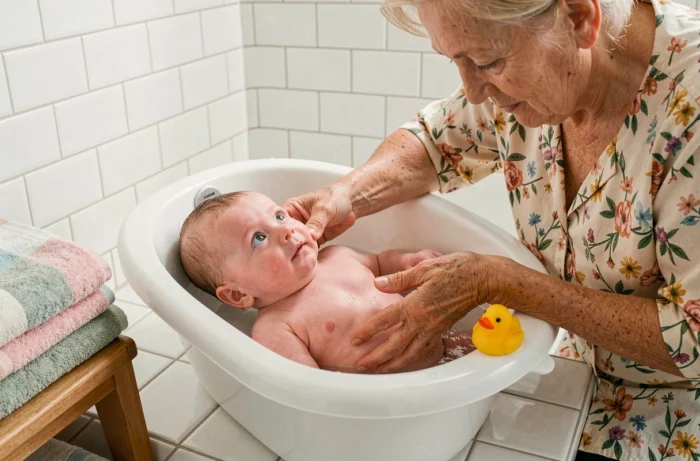
A daily bath is not mandatory in the first weeks. Two to three baths per week are sufficient, complemented by a washcloth for the face, neck, and folds. Too many baths can dry out the infant’s delicate skin.
- Clean the umbilical cord with a sterile compress and water until it falls off naturally, without applying antiseptic unless medically indicated
- Use saline solution to clean the nose and eyes, morning and evening, or in case of congestion
- Cut the baby’s nails only when they exceed the fingertip, using rounded-tip scissors, preferably while they are sleeping
- Monitor for redness in the folds (neck, armpits, groin) that signal maceration and require more attentive drying
Diaper changes should happen with every soiled diaper, without waiting for a fixed schedule. Wipes are handy when out, but water and cotton remain the reference at home to limit irritations.
Reading and Stimulation from Birth: No Need to Wait
We often underestimate the importance of talking and reading to an infant from the very first weeks. The baby does not understand the words, but they pick up on intonations, the rhythm of the voice, and physical closeness.
High-contrast board books (black and white, then bright colors) capture attention from the first weeks of life. Reading them aloud during diaper changes or feedings creates a ritual that structures the day without requiring extra time.
Supporting a baby daily relies less on accumulating equipment and more on the consistency of simple actions: a safe sleeping environment, feeding adapted to their rhythm, measured hygiene care, and attention to the emotional state of the parents. The perfect equipment will never replace the attentive presence and stable markers that are established day by day.