
Élodie Villemus reports an annual revenue that she summarizes herself with a formula that has gone viral: “almost half a million euros.” Behind this overall amount lie several distinct revenue streams, of which the share related to the show 4 weddings for a honeymoon represents only a fraction. Analyzing these sources of income helps to understand what a television expert specializing in weddings actually earns.
Distribution of Élodie Villemus’s income by activity
Élodie Villemus’s public statements in a podcast dedicated to the income of professionals allow us to reconstruct the breakdown of her revenue. Three main categories stand out clearly.
| Source of income | Estimated share of revenue | Details |
|---|---|---|
| Training (franchise and coaching) | 61% of revenue | First wedding planning franchise in France, training for wedding planners |
| High-end weddings | Minority share but with high unit value | Fewer weddings than in her early days, but much higher budgets per event |
| Television (4 weddings for a honeymoon) | Complementary share | Role as an expert and host on TF1 since 2019 |
The main observation can be summed up in one line: training generates more than half of her income, far ahead of wedding organization and television combined. This structure explains why reducing Élodie Villemus to a “TV salary” misses the economic reality of her activity.
To better understand Élodie Villemus’s salary in 4 weddings for a honeymoon, it is necessary to distinguish the compensation paid by the production from the overall revenue of her business.
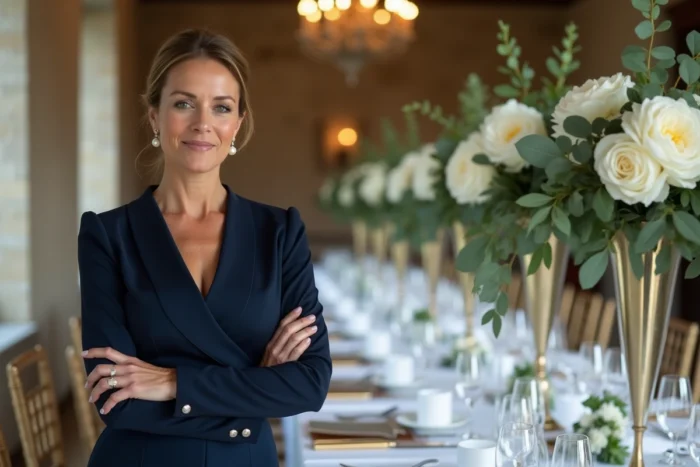
Salary of a TV expert in 4 weddings for a honeymoon
The TF1 production has never disclosed the exact amount paid to Élodie Villemus per episode or per season. No reliable public source allows for precise quantification of this compensation.
What we do know is that the television fee is not her main source of income. The share of television in her overall revenue remains complementary compared to training and live wedding organization.
The role of expert in the show functions more as a lever for notoriety. Exposure on TF1 since 2019 fuels demand for her training and high-end services, which indirectly boosts the other two revenue streams.
Comparison with the initial career
Before transitioning to the current model, Élodie Villemus organized 18 to 20 weddings per year with budgets of 20,000 to 30,000 euros per event. Her fees were around 4,000 euros per wedding, resulting in annual revenue of 70,000 to 80,000 euros, at the cost of 90-hour weeks.
The trajectory is clear: fewer weddings, better paid, and above all a pivot towards training and franchising. The move to television accompanied this transformation without being the main financial driver.
Income of wedding planners in France: market context
Élodie Villemus’s journey does not reflect the reality of most wedding planners. Her case is atypical due to the combination of three factors: national media exposure, franchise creation, and high-end positioning.
- A beginner wedding planner typically charges fees well below 4,000 euros per event, often as a percentage of the overall wedding budget.
- The volume of weddings organized per year is limited by seasonality (the majority of ceremonies are concentrated between May and October) and by the preparation time for each event.
- Diversifying income (training, consulting, online content) has become a growth lever for established professionals, but remains inaccessible to those just starting out.
The wedding market in France is experiencing a particular dynamic: couples are marrying less but investing more in each celebration. This trend favors providers positioned in the premium segment, which partly explains Élodie Villemus’s upscale shift.

Who pays the experts in wedding shows on TF1
The question of funding for experts in this type of show often arises. It is the production that pays the contributors, not the contestants or the viewers. The participants do not receive a salary for their appearance: they finance their own wedding and compete for the honeymoon offered by the production.
This distinction is fundamental. The expert is a professional under contract with the production company. Her fee is negotiated independently of the budgets of the filmed weddings.
Personal branding as a revenue multiplier
The show has provided Élodie Villemus with what most wedding planners never achieve: a recurring national audience. This visibility is then monetized through training, franchising, and premium services.
Élodie Villemus’s business model thus relies on a virtuous circle where television feeds notoriety, notoriety attracts high-end clients and training candidates, and training represents the largest source of revenue with 61% of the total. The TV fee, as appreciated as it may be, remains a cog in a larger mechanism than just a host’s salary.