
A parent comes home from work, puts down their things, and the children are already demanding attention while dinner waits. This transition moment, often chaotic, can become the first concrete lever to strengthen family bonds on a daily basis. No need to plan an entire weekend: it is in the first twenty minutes after returning home that a good part of family connection takes place.
Micro-rituals of transition: the gateway that changes the evening
Since the post-COVID period, many families have maintained what are called daily micro-rituals of reunion. The principle is simple: we allow ourselves about twenty minutes without screens and without logistical demands right after returning home. Everyone settles down, decompresses, and the first interactions happen without pressure.
In practice, this can take the form of a systematic hug upon arrival, a quick round of the table where everyone shares a moment from their day in one sentence, or simply a glass of water shared together in the kitchen. The idea is not to create a spectacular ritual, but to protect a calm time before the evening obligations.
You can also access the family page of Partagez to find shared activity formats that easily fit into these short time slots.
This transition gateway works because it breaks the rhythm of the day. Parents stop functioning in task mode, and children feel that we are available. Feedback from families practicing this type of routine shows a notable decrease in evening tensions.
Weekly family meeting: an underestimated format for communication
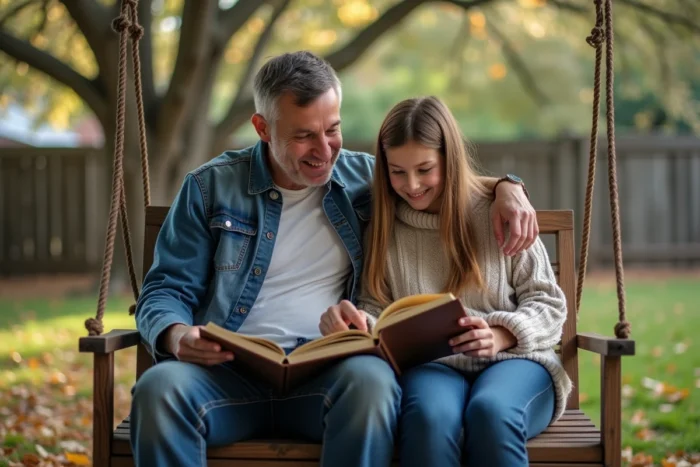
Family meetings are often associated with crisis situations, a conflict between siblings, or a behavioral issue. Their true potential lies elsewhere: when used regularly, they become a conflict prevention tool and a space where each member, including the youngest, learns to express what they feel.
Establishing a simple framework
We set a short time slot, about twenty minutes on Sunday evening, for example. Each person takes turns speaking on three points: what went well this week, what posed a problem, and what we would like to do together the following week.
Children participate as soon as they can express themselves. We note decisions in a notebook or on a visible board so that commitments do not remain abstract. This format is directly inspired by documented practices in family therapy, where the regularity of the meeting matters more than its duration.
Adapting according to children’s ages
With young children, we simplify: a drawing of the week, a word about what made them happy or sad. For teenagers, feedback varies on this point, but offering a non-intrusive framework often works better than an interrogation about their day. The fact of giving the floor without the obligation to justify themselves changes the dynamic.
Shared meals and collective cooking: concrete moments of family bonding
Preparing a meal together remains one of the most effective activities for creating complicity. We are not talking about gastronomy; we are talking about involving each member in a specific task: one child washes the vegetables, another stirs the sauce, a parent supervises the cooking.
Collective cooking generates spontaneous exchanges. We chat while peeling carrots, negotiate the menu for the next day, pass on a gesture learned from our own parents. These culinary memories create intergenerational bonds effortlessly.
- Assign one evening a week where a child chooses the recipe and actively participates in its preparation, from selecting the ingredients to plating the dish.
- Establish a screen-free meal (no phones, tablets, or television in the background) at least three times a week to encourage conversation.
- Use the meal to ask an open question to each person, for example, “What was the funniest moment of your day?” rather than the classic “Did you have a good day at school?”
Acts of kindness in the family: creating a culture of mutual attention
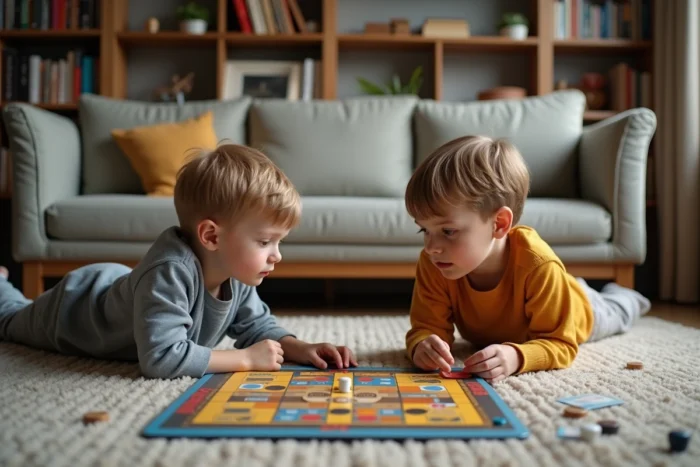
A rarely addressed lever in family life advice concerns small intentional acts of kindness between household members. We are not talking about basic politeness, but deliberate actions: leaving a note in a child’s backpack, making a partner’s coffee without being asked, tidying up a sibling’s room as a surprise.
These gestures create a virtuous circle. Children who see their parents practicing free attentions replicate the behavior. The sense of belonging to the family group is strengthened because everyone feels noticed and valued.
Making the practice visible
Some families use a transparent jar in which each member deposits a paper describing an act of kindness they have observed in another. We read the papers together at the end of the week. This system works particularly well with children aged five to twelve, who enjoy the concrete and visual aspect.
- Write a positive note on a post-it and stick it in an unexpected place (bathroom mirror, snack box, pillow).
- Spontaneously offer to help another member with a chore that does not concern us.
- Verbalize gratitude out loud during the meal: say precisely why we are thanking someone, not just “thank you.”
Strengthening family bonds on a daily basis does not require extraordinary activities or long-planned weekends. Families that maintain a strong connection share a common point: they protect short but regular times where everyone exists outside of logistics. An evening transition gateway, a weekly meeting, a meal prepared together, or a gesture of attention slipped into the routine is enough to change the quality of exchanges over time.