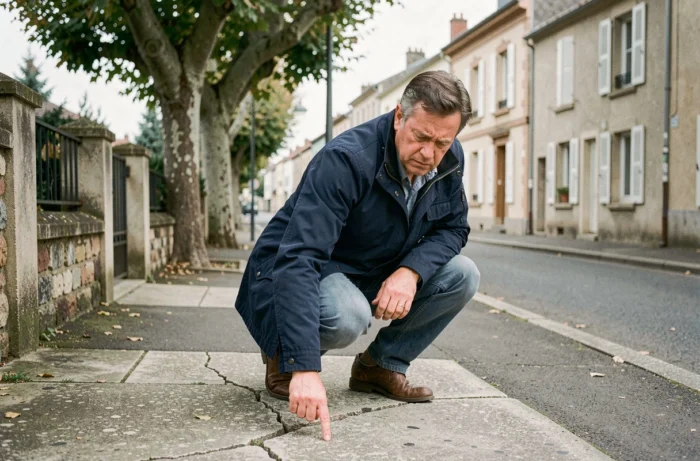
The sidewalk in front of a home is part of the municipal public domain. Even when it runs directly alongside a building façade or fence, it does not belong to the adjacent property owner. This rule applies to almost all municipal roads in France, whether it is a busy urban street or a road in a residential development.
The confusion stems from the fact that many municipalities delegate some routine maintenance to residents. This delegation, governed by municipal orders, does not transfer any ownership rights. It does, however, create specific obligations whose scope varies depending on the type of work involved.
Sidewalk ownership: public domain and the boundaries of private property
A sidewalk is part of the municipality’s public domain when it borders a designated municipal road. The land registry precisely marks the boundary between private property and public land. In most cases, this boundary runs along the façade or boundary wall.
Residents who want to check who owns the sidewalk in front of their home can consult the cadastral map available at the town hall or online. A boundary survey carried out by a licensed surveyor can resolve any doubts in the event of a dispute over the property line.
This public-domain status has a direct consequence: residents may not alter the sidewalk, install furniture on it, or plant vegetation there without prior authorization from the town hall. Any use of the space (flower box, ramp, patio) requires a temporary occupancy permit.

Maintenance obligations by type of work
Sidewalk maintenance is not a single, all-encompassing responsibility. Duties are divided differently depending on the type of work. The municipal regulations (or mayor’s police order) determine how responsibilities are allocated locally. Each municipality can adapt these rules.
Routine cleaning and weed removal
Most municipal orders require residents to regularly sweep the section of sidewalk alongside their property. This obligation covers collecting fallen leaves, removing litter and, often, removing weeds from the joints between paving slabs.
Failure to meet this obligation may result in a formal notice, followed by a fine. The municipality may also arrange for the work to be carried out and charge the costs to the resident in default.
Snow and ice removal
Clearing the sidewalk in front of your home is the best-known maintenance obligation for residents. A municipal order generally specifies the timing and requirements, such as clearing snow and spreading salt or sand.
- Residents must clear a passable path of the width specified in the order (often the full width of the sidewalk or a minimum width that allows pedestrians to pass).
- Cleared snow must not be pushed into the road or in front of a neighboring property; it should be piled along the gutter.
- If a pedestrian falls on an untreated icy sidewalk, the resident may be held civilly liable if a municipal order required them to clear the snow.
Repairing and resurfacing the sidewalk
Structural sidewalk repairs (broken paving slabs, subsidence, potholes) are the municipality’s responsibility as owner of the public domain. Residents are neither required nor entitled to carry out this work themselves.
If a surface defect causes an accident, the municipality may be held liable for failing to properly maintain the public infrastructure. The appropriate course of action is to report the problem to the town hall in writing, by letter or online form.
Accessibility improvements
Lowering curbs at pedestrian crossings, installing tactile paving and widening paths for people with reduced mobility are accessibility improvements that are the municipality’s sole responsibility. Residents cannot object, even if the work changes the appearance of the sidewalk in front of their property.

Check the municipal regulations that apply to your sidewalk
The obligations described above are not the same everywhere. Each municipality has its own police order, sometimes supplemented by road regulations. Two points should always be checked.
- The list of tasks actually delegated to residents: some municipalities require only snow removal, while others also require sweeping, weed removal or watering around trees.
- Deadlines and times: an order may require snow to be cleared before 8 a.m. or sidewalks to be swept weekly.
- Applicable penalties: fines vary according to local regulations, and some municipalities arrange for the work to be done and bill the resident.
The order can be consulted at the town hall and is sometimes available on the municipality’s website. In designated or protected areas, additional restrictions may apply, such as rules on weed-removal methods or bans on certain chemicals.
Liability for sidewalk accidents
Liability depends directly on the obligation involved. If a pedestrian falls on an icy patch and a municipal order required the resident to clear the snow, the resident may be held liable in civil court.
However, if the accident is caused by a hole in the surface or a design defect, the municipality is responsible for failing to maintain its public domain. The administrative court then has jurisdiction.
The distinction between the two liability regimes comes down to the difference between routine maintenance (which may be delegated to residents) and structural maintenance (which always remains the local authority’s responsibility). Keeping written records of reports made to the town hall can help protect residents from unjustified claims.
The sidewalk remains municipal property, but residents are largely responsible for its day-to-day upkeep. Checking the municipal order before winter arrives or when moving into a new home can help avoid surprises, whether it concerns snow removal, weed removal or simply sweeping.