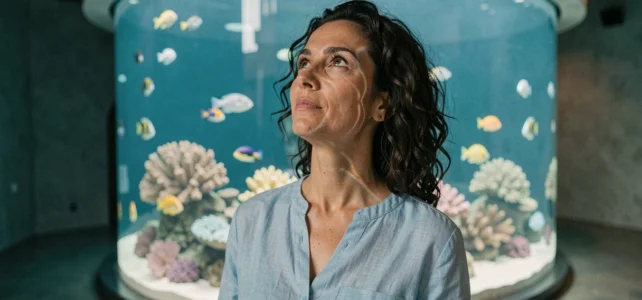
The aquarium of La Ciotat offers a dive into Mediterranean marine ecosystems, just a stone’s throw from the coastline of Bouches-du-Rhône. Unlike large generalist oceanographic complexes, this place focuses on local fauna and flora, giving it an educational role rooted in the territory.
Marine Protected Area of Mugel Bay: What the Aquarium Makes Visible
In April 2025, a strict marine protected area was established in Mugel Bay and Sec Bay, prohibiting any recreational fishing over nearly ten hectares. Artisan fishing remains highly regulated. This decision reflects a reality: the coastal biodiversity of La Ciotat is under pressures that require radical measures.
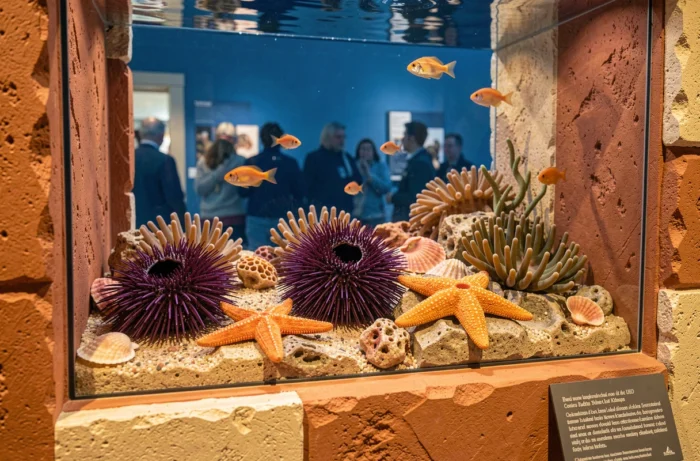
The aquarium provides a direct extension of this reality. Observing species in a tank that inhabit these protected areas helps to understand what the regulations aim to preserve. Rockfish, posidonia meadows, and invertebrates attached to rocky substrates: these organisms are often invisible to swimmers or walkers.
For families planning to visit the aquarium of La Ciotat, this ecological context adds a whole new dimension to the visit. The connection between the tanks and the sea visible from the city’s coastline makes the experience tangible, far from abstract presentations about biodiversity.
Aquarium of La Ciotat and Family Activities: A Child-Friendly Format
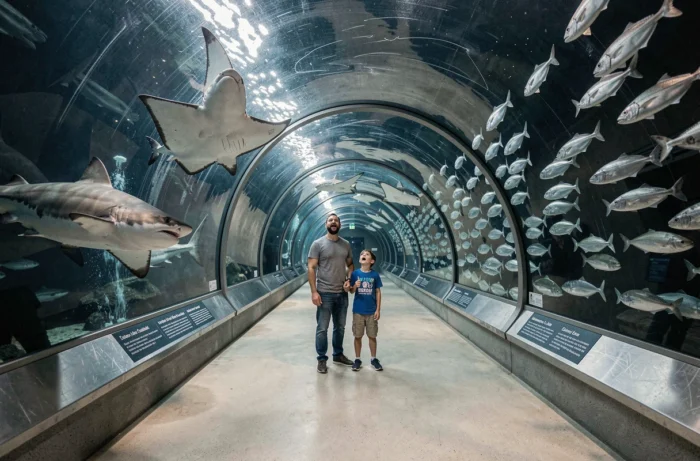
The large aquariums in the region, especially those near Marseille, focus on the spectacular: immersive tunnels, sharks, giant jellyfish. The aquarium of La Ciotat takes a different approach. Its modest size allows for child-level visits, without endless queues or marathon routes.
This short format is particularly suitable for young children. The visit duration aligns with their attention span, and the proximity to the tanks encourages direct observation. The explanatory panels, focused on local fauna, avoid the syndrome of exotic species catalogs unrelated to the territory.
What Distinguishes a Local Visit from a Generalist Zoo
A zoo presents species from around the world in an artificial setting. The aquarium of La Ciotat reverses this logic: the exhibited species live just a few hundred meters away, in the calanques or the bay. A child observing a sea urchin in a tank can find it while snorkeling in the afternoon.
This geographical coherence is not trivial. It structures an experiential learning that remains rare in the region’s classic tourist activities.
Coastal Walk and Aquarium Visit: Combine Both in One Day
La Ciotat offers a network of coastal walks that naturally complement the aquarium visit. The Mugel Park, trails to the calanques, and access to the Île Verte by boat form a coherent set around the discovery of the marine environment.
- The Mugel Park provides access to dense Mediterranean vegetation and viewpoints over the bay, where the species presented in the aquarium live
- The Île Verte, accessible by boat shuttle, allows immersion in a preserved island ecosystem, with rich seabeds
- The coastal paths between the port and the calanques offer direct contact with limestone rock and coves, natural habitats for local fauna
Organizing the aquarium visit in the morning, then following up with a walk or a sea outing, creates a full day without repetition. The aquarium provides the keys to understanding, and the field confirms them.
La Ciotat Coast in 2025: A Context that Enhances the Aquarium’s Interest
The coastline of La Ciotat is undergoing a period of regulatory transformation. In 2025, the limit of the public maritime domain was redefined over approximately 630 meters between the Henri-Langlois esplanade and the Saint-Jean port. This decision led to the removal of sun loungers and private beach equipment due to lack of occupancy authorization.
These changes concretely alter the visiting experience in La Ciotat. The shoreline regains a more natural character in certain areas, making the discovery of the marine environment even more relevant. The aquarium fits into this dynamic: understanding what lives beneath the surface takes on new meaning as the coastline itself evolves.
Why Local Marine Biodiversity Deserves a Detour
The Mediterranean harbors a remarkable proportion of the world’s marine biodiversity in a small area. The coast between Marseille and La Ciotat, integrated into the perimeter of the Calanques National Park, hosts varied habitats: submerged cliffs, meadows, underwater caves.
The aquarium reflects this richness in a space accessible to all, including visitors who do not dive. For families, children, or people with reduced mobility, it is often the only way to observe these species in realistic conditions.
The visit to the aquarium of La Ciotat is not just a tourist leisure activity among others. It is based on a real marine ecosystem, protected by recent measures, and is linked to a territory where each coastal walk extends what has been observed in the tanks. It is this connection between the inside and the outside, between the tank and the calanque, that gives this visit its particular value.