
The Kems relies on a rare mechanism in card games: victory depends on a non-verbal signal between partners, not on the brute strength of a hand. This feature makes it a game where behavioral reading takes precedence over combinatorial strategy. Here, we detail the tactical subtleties that separate a chaotic game from a controlled round.
Secret signal in Kems: design and counter-espionage
The choice of the secret sign is the main strategic lever. A signal that is too visible (scratching your ear, coughing) will be intercepted by the opposing team by the second round. A signal that is too discreet risks never being picked up by your partner.
We recommend working on contextual micro-signals rather than isolated gestures. Placing a specific card in a precise spot in the center, altering the rhythm of exchanges, or changing the position of your cards in hand: these signals blend into the flow of the game and are less susceptible to opposing observation.
The real trap lies in consistency. If you touch your chin only when you have a set, an attentive opponent will notice it in two rounds. Mix in false positives, distracting gestures that you reproduce even without a set, to confuse the reading. To delve deeper into each step of the game mechanics, the Kems rules on Scooporama detail the entire process.
Counter-espionage works in a mirror fashion. During exchanges, dedicate part of your attention not to your own cards, but to the behaviors of the opposing team. A player who suddenly slows down their exchanges with the center has likely completed or nearly completed their set.

Center management and exchange tempo in Kems
The simultaneous play without turns creates a dynamic that most guides underestimate. The tempo of exchanges determines the control of the round. A fast player forces others to react rather than build, leading to reading errors and impulsive exchanges.
Center management follows a simple principle: never keep a card “just in case.” Every card in your hand should serve your goal of completing a set. If you hesitate between two values to collect, make a quick decision. Changing strategy mid-round costs several exchanges and gives a speed advantage to the opponent.
Blocking the center to slow down the opponent
An advanced tactic involves exchanging a useful card for a card from the center that you know the opponent needs, solely to temporarily remove it from play. This block works especially well with four players, where the visible cards in the center circulate quickly.
The risk: you pollute your own hand with a useless card. This approach is only justified if you already have three identical cards and are just one exchange away from completing the set. In this case, slowing down the opponent while your partner sends you the signal is worth the temporary sacrifice.
Counter-Kems: when and how to announce it
The “Counter-Kems” announcement is the most powerful defensive weapon in the game. It allows the opposing team to block an ongoing Kems if they spot that a player has a set before their partner shouts “Kems.” In the case of a successful counter-Kems, it is the team holding the set that loses the round.
The timing is delicate. A counter-Kems called too early, based on mere suspicion, backfires if the targeted player does not have a set. The conditions for attempting a reliable counter-Kems are:
- You have observed a player stop exchanging with the center for several seconds, a sign that they are protecting their complete hand
- An unusual gesture has just been made between the two opposing partners, corresponding to a pattern noted in previous rounds
- The partner of the suspicious player changes attitude (smiling, intense gaze, hesitation before speaking)
In case of doubt, refrain. A failed counter-Kems gives a free point to the opponent and disrupts your defensive dynamic for the following rounds.
Kems with six or eight players: adapting the rules
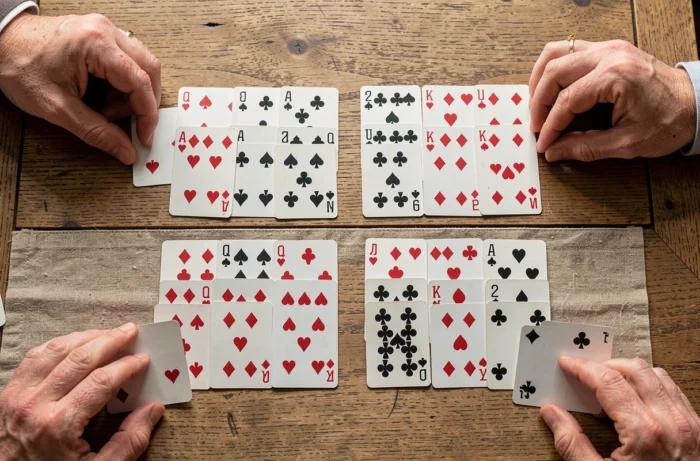
The classic configuration of four players (two teams of two, partners facing each other) remains the reference. Moving to six or eight players profoundly changes the balance of the game.
With three teams of two around the table, the surveillance is fragmented among several opponents. Spotting a signal becomes more difficult as you have to observe four players instead of two. The center also rotates faster, reducing the time available to build a set.
We observe that games with six players favor visual signals over gestural ones. A wink or a sustained gaze can be transmitted from a distance even when the table is crowded, while a discreet hand gesture goes unnoticed in the general commotion.
Adjusting the number of cards in the center
Some groups increase the number of visible cards in the center (five or six instead of four) to compensate for the increased speed of exchanges. This variant smooths the game but dilutes the tension: with more choices available, sets form faster and rounds shorten.
TV broadcasts and commercial versions: Kems beyond the standard 52-card deck
Kems has transcended the realm of informal play. CANAL+ produced a dedicated show hosted by Ramzy Bedia, bringing together comedians like Florence Foresti, Manu Payet, or Fabrice Éboué around filmed games. This format has helped introduce the game to an audience that had never handled a deck of cards in this context.
On the material side, publishers have launched commercial versions with dedicated components, actively distributed in the board game circuit. These editions sometimes add special cards or bonus mechanics, but the core of the game remains the same: a set, a signal, an attentive partner.
Kems remains a game whose richness comes from human interaction, not from material. A standard 52-card deck is enough to produce tense and memorable games, provided you focus on two things: the choice of signal and reading the opponents. Everything else stems from these two pillars.