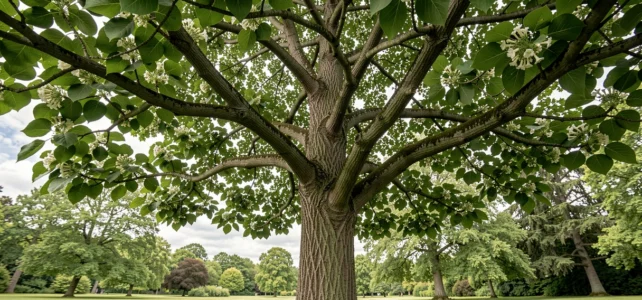
The catalpa belongs to the Bignoniaceae family. Understanding the history and symbolism of the catalpa requires going back a long way before even addressing its horticultural uses.
Taxonomy of the catalpa: a genus that resists classifications
Molecular studies have significantly reduced the number of recognized species within the genus Catalpa. Several taxa once considered distinct species have proven to be synonyms, hybrids, or mere regional forms.
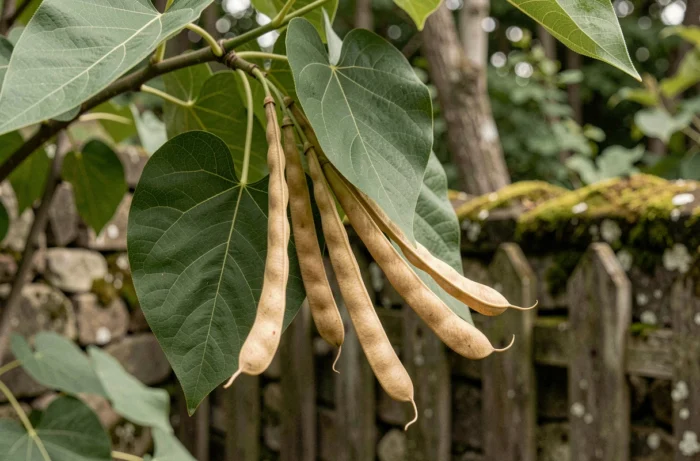
This taxonomic instability can be explained by the strong morphological similarity between species, particularly between Catalpa bignonioides (native to the southeastern United States) and Catalpa speciosa (Mississippi Valley). Whorled leaves, thyrsoid panicle flowers, and long pod fruits are found in both species, complicating field identification.
The genus Catalpa is also closely related to the genus Paulownia by non-specialists, while the latter belongs to the Paulowniaceae. The confusion arises from the resemblance of the heart-shaped leaves and the overall growth habit, but the floral structure and seed arrangement differ radically. To delve deeper into the history and symbolism of the catalpa tree, one must move beyond these common confusions.
Catalpa bignonioides and speciosa: technical differences between the two North American species
Catalpa bignonioides produces denser and shorter inflorescences than those of speciosa. The flowers of bignonioides have more pronounced purple spots inside the corolla, a reliable criterion for distinction during the flowering period.
The wood of speciosa is more durable when in contact with the soil. Bignonioides, more compact in adult size, has been favored as an ornamental tree in Europe since its introduction in the 18th century by the naturalist Mark Catesby, who described the genus after his observations in Carolina.
The case of Chinese species
Two species native to China complete the picture: Catalpa ovata and Catalpa bungei. The catalpa holds a place in traditional Chinese pharmacopoeia. Recent pharmacological studies reevaluate the bioactive compounds present in the bark and fruits, particularly iridoids and phenolic derivatives that are the subject of in vitro studies.
Role of the catalpa in urban adaptation strategies to warming
We have observed a resurgence of interest in the catalpa in urban greening plans for several years. Its broad and dense canopy, heat tolerance, and ability to withstand compacted soils make it a serious candidate for cool island policies in urban areas.
In Brest, a remarkable catalpa in the city center recently benefited from a mechanical support system (a prop) to extend its lifespan and maintain its role as a local thermal regulator. This type of intervention illustrates the value that communities now place on established large trees.
A status of exotic species to monitor
The catalpa, widely planted but still little studied from an ecological perspective, appears in some European inventories as an exotic species to monitor. It is not regulated to date, but monitoring programs ensure it does not shift towards an invasive status, particularly through the dispersion of its winged seeds in riparian environments.
- Its naturalization capacity remains limited in most temperate regions, with spontaneous seedlings rarely being viable without prolonged summer heat.
- Local inventories classify it as “established non-problematic exotic,” an intermediate status that could evolve with climate change.
Symbolism of the catalpa: between protection and resistance
In Native American traditions, the catalpa is associated with protection. Its large heart-shaped leaves, which can exceed the size of an open hand, make it a symbol of shelter. European settlers nicknamed it the “bean tree” or “cigar tree” in reference to its long hanging pods, sometimes confused from a distance with edible fruits.
The symbolism of the catalpa varies across continents. In China, the catalpa is traditionally planted near homes to signify familial rooting. In the West, its spectacular yet brief flowering has inspired metaphors about the ephemeral and generosity.
We recommend not reducing the catalpa to its aesthetic interest alone. Its botanical history, marked by multiple discoveries across three continents, its pharmacological uses currently being reevaluated, and its emerging role in climate urbanism make it a genus whose significance far exceeds that of mere ornamental gardens. The catalpa is a tree whose relevance is now measured at the scale of cities, not just private plots.