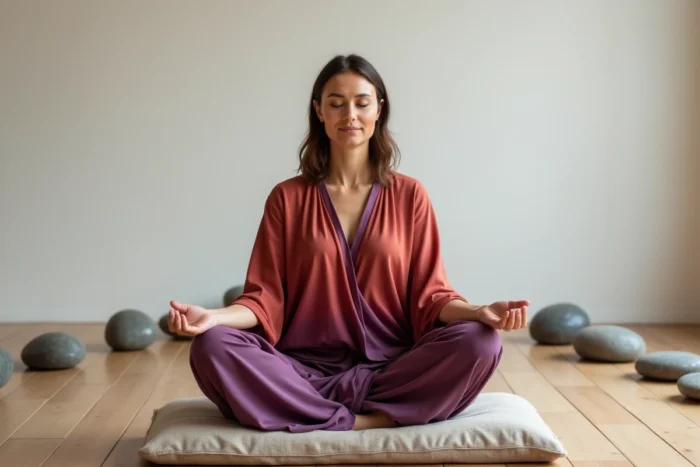
In yogic tradition, chakras refer to energy centers located along the spine, from the base of the pelvis to the crown of the head. Each chakra is associated with a specific color, determined by its own vibrational frequency. This correspondence between color and energy forms the basis of many meditation and yoga practices aimed at restoring the body’s balance.
Vibrational frequency and light spectrum: why each chakra has its color
The color assigned to each chakra is not a decorative choice. It stems from a principle of correspondence between vibrational frequency and light wavelength. Red, associated with the root chakra, has the longest wavelength in the visible spectrum and vibrates at a low frequency. Purple, linked to the crown chakra, is at the opposite end with a short wavelength and a high frequency.
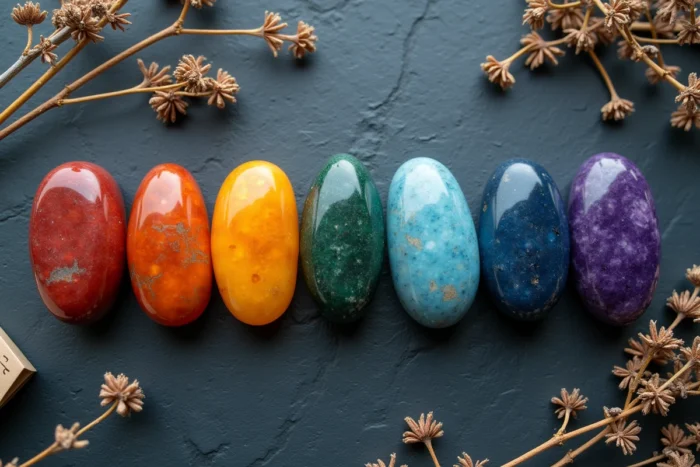
This gradient follows exactly the order of the light spectrum: red, orange, yellow, green, blue, indigo, violet. The progression goes from the densest (root, physical grounding) to the subtlest (crown, spiritual dimension). Each energy center has its own pulse, density, and frequency.
To delve deeper into the colors of the chakras and their role in energy regulation, understanding this link between the light spectrum and vibration provides a solid initial reference.
The seven colors of the chakras and their energetic function
Rather than detailing each chakra individually, grouping the seven centers by functional area allows for a better understanding of their overall logic.
Lower zone: grounding and vitality
The first three chakras manage the relationship to the physical body and fundamental needs.
- The root chakra (red), located at the base of the spine, governs security, stability, and grounding. An imbalance often manifests as anxiety or a feeling of insecurity.
- The sacral chakra (orange), located below the navel, governs emotions, creativity, and sensuality. It is linked to the reproductive organs and kidneys.
- The solar plexus chakra (yellow), located at the stomach level, concentrates willpower and self-confidence. It is the center of personal power.
Middle zone: the heart as a pivot
The heart chakra (green) occupies a central position in the system. It connects the physical chakras (lower) and the spiritual chakras (upper). This center governs love, compassion, and the ability to form connections. Its imbalance can manifest as emotional withdrawal or, conversely, emotional dependency.
Upper zone: expression and consciousness
The last three chakras concern communication, perception, and spiritual connection.
- The throat chakra (blue) governs verbal expression, listening, and authenticity. A blockage at this level manifests as difficulty in expressing oneself or setting boundaries.
- The third eye chakra (indigo), located between the eyebrows, is associated with intuition, mental clarity, and discernment.
- The crown chakra (purple), at the top of the head, represents the connection to a dimension that transcends the individual, often described as universal consciousness.
Chakra colors and meditation: how visualization affects the body
Colors serve not only as theoretical markers. They are an active tool in meditation and yoga practices. Visualizing a specific color during a meditation session allows for focused attention on the corresponding chakra.
This mechanism is based on a simple principle: colors act as visual stimulators that activate the nervous system. They influence mood, emotions, and thoughts, making them concrete supports for meditation and visualization sessions.
In practice, a meditation focused on the heart chakra involves visualizing a deep green at the center of the chest, synchronizing this image with the breath. For the root chakra, visualizing a dense red at the base of the spine accompanies grounding work.
Modern approaches in neuroscience are beginning to analyze these states of deep meditation in terms of brain activity and stress regulation. The assessment remains nuanced, with measurable effects on certain parameters and unresolved hypotheses on others.
Stones and chakra colors: complementarity or marketing
The market for chakra-related products (bracelets, stones, vibrational boards, energy decorative objects) has seen sustained growth in recent years. According to a Statista study reported in 2024, this segment shows a significant growth rate globally.
This popularity deserves a clear-eyed perspective. The association between a stone and a chakra is based on a color correspondence, not on a demonstrated physical mechanism. An amethyst (purple) is associated with the crown chakra, a carnelian (orange) with the sacral chakra. These correspondences follow the same chromatic logic as the chakra system itself.
The value of these objects lies more in their function as intentional supports. Holding a stone during meditation focuses attention and creates a ritual. The risk arises when the object replaces practice instead of accompanying it.
There is also a recent trend to integrate chakra-related practices into structured therapeutic frameworks (therapeutic yoga, sophrology, stress management programs in hospital settings). This evolution marks a gradual shift from the solely esoteric realm to a more structured approach.

The grid of the seven chakra colors provides a framework for reading the energy body that remains consistent with traditional Indian texts. Its practical usefulness depends less on belief in a vibrational system than on the ability to use it as a tool for concentration and self-observation during meditation or yoga. A chakra does not need to be scientifically validated for the accompanying practice to produce a measurable effect on stress or attention.