Virginie Bustin is not just a name associated with Jean-Baptiste Guégan. Her artistic practice is based on a multidisciplinary approach that combines visual arts, ceramics, and mediation with diverse audiences. Understanding Virginie Bustin’s profession requires going beyond a simple celebrity portrait to examine her working methods, creative positioning, and the coherence of her universe.
Ceramics and Studio: The Technical Foundation of Virginie Bustin
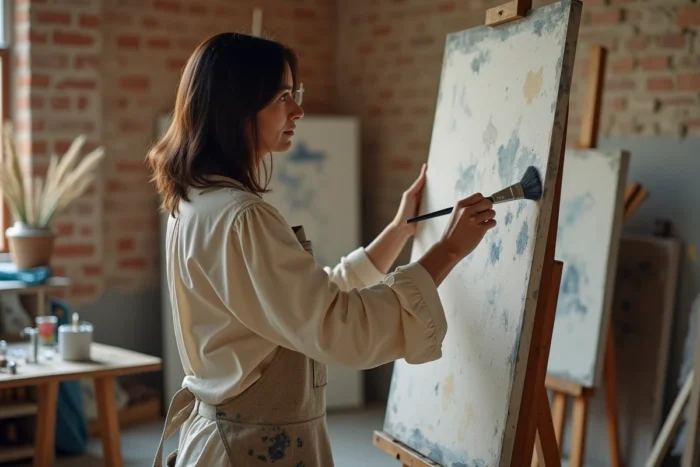
Ceramics play a structural role in Virginie Bustin’s approach. She has a studio where she produces pieces that she then distributes online, demonstrating an organized artistic activity rather than a mere hobby. This mode of operation (production, visual documentation, digital distribution) corresponds to the economic model adopted by many professional ceramists in France.
We observe that articles dedicated to Virginie Bustin consistently overlook this dimension. Discussing her journey without mentioning her studio practice is akin to describing a musician without referencing their instrument. The studio is not a backdrop: it is the place where a regular and documented ceramic production is built.
To better understand Virginie Bustin’s profession, one must observe how she articulates manual creation and digital presence, two skills rarely mastered simultaneously in the applied arts sector.
Artistic Mediation and Workshops for Young Audiences
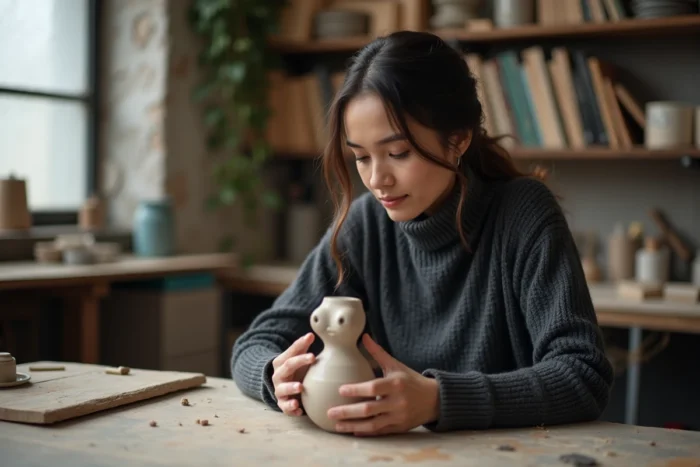
A less visible but crucial aspect of her activity concerns artistic mediation with children. Virginie Bustin works particularly in kindergarten classes, where she leads ceramics workshops combined with sensory activities related to nature. This type of intervention requires specific pedagogical skills, far beyond mere technical mastery of the material.
Leading a ceramics workshop with young children demands adapting tools, rethinking drying times, and managing the sensory relationship with clay. Artists who engage in this form of mediation often build their legitimacy on the ground before formalizing it through training or certifications.
What the Choice of Young Audiences Reveals
Working with preschoolers means accepting that the aesthetic result takes a back seat. The goal becomes sensory awakening, the discovery of touch, and free manipulation. This stance places Virginie Bustin on the side of art education, a professional field distinct from pure creation that mobilizes transmission skills.
The workshops also include observing insects (stick insects) and exploring nature, which grounds the approach in a holistic view of living beings. This is not anecdotal: it structures a coherent creative universe where matter, gesture, and the natural environment form a whole.
Creative Universe of Virginie Bustin: Nature, Sensitivity, and Relationship with the Living
Virginie Bustin’s artistic universe revolves around recurring themes: nature, animals, and contact with living beings. Jean-Baptiste Guégan himself regularly mentions this shared attachment to nature and animals, which brings, in his own words, “peace and serenity” to daily life.
This common thread is not decorative. In the field of visual arts and contemporary ceramics, the relationship with the living constitutes an artistic positioning claimed by many creators. It influences the choice of materials (clay, natural pigments), the forms produced (organic, irregular), and the preferred exhibition or distribution venues.
Coherence Between Personal Life and Artistic Approach
We recommend not artificially separating private life and professional practice in this type of profile. Artists whose universe is based on sensitivity to the living build their creative identity from their daily lives. The presence of animals, the rural or semi-rural setting, and walks in nature are not mere biographical details: they are direct sources of production.
This intertwining of life and art also explains why Virginie Bustin remains relatively discreet on mainstream social media. Her communication relies more on visuals (Instagram, publications of works) than on personal staging.
Hybrid Professional Profile: Artist, Mediator, and Collaborator
Virginie Bustin’s profile cannot be reduced to a single label. Three dimensions coexist in her practice:
- Ceramic creation in the studio, with the production and distribution of original pieces, documented and shared online through visual networks.
- Artistic and pedagogical mediation, particularly with young audiences, involving interventions in schools that combine ceramics, nature, and sensory awakening.
- Professional collaboration with Jean-Baptiste Guégan, in a context where she participates in the organization and creative environment of the singer, as he has publicly confirmed.
This triptych is characteristic of multidisciplinary artists who refuse to confine themselves to a single distribution circuit. The presence of an active LinkedIn profile also suggests a desire to structure this activity beyond the informal artistic circle.
Why This Profile Escapes Traditional Categories
Celebrity media classify Virginie Bustin as a “partner of.” Cultural sites do not yet list her as an established ceramist. This ambiguity is common among artists in the process of professional structuring, who combine production, teaching, and collaboration without any of these activities overshadowing the others in terms of media visibility.
Virginie Bustin’s journey illustrates a common reality in the French artistic community: multi-activity is not a lack of focus, but a mode of operation suited to a sector where living from a single discipline remains the exception. Ceramics, mediation, and collaboration form a coherent professional ecosystem, driven by a sensitive universe centered on nature and gesture.