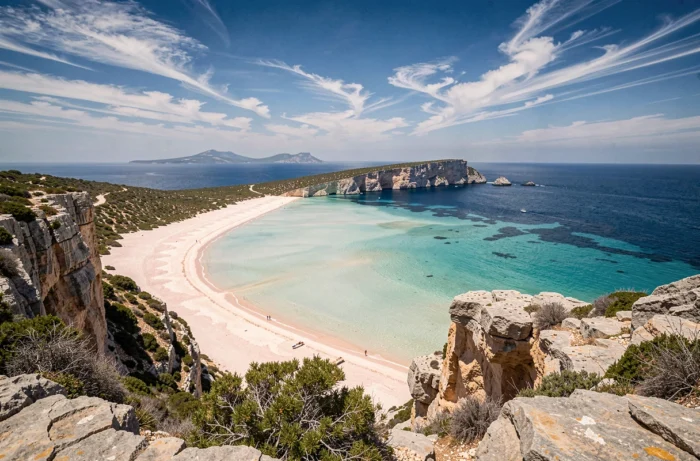
Balos Beach, located in the far northwest of Crete, attracts a considerable crowd each year to its turquoise lagoon. Behind this postcard landscape lie layers of stories that are much older than beach tourism. Tales of pirates, traces of Minoan civilization, Venetian fortifications, and local legends imbue this stretch of Cretan coast with a narrative depth that mere swimming does not reveal.
Gramvoussa Fortress and Pirate Memory in Balos Bay
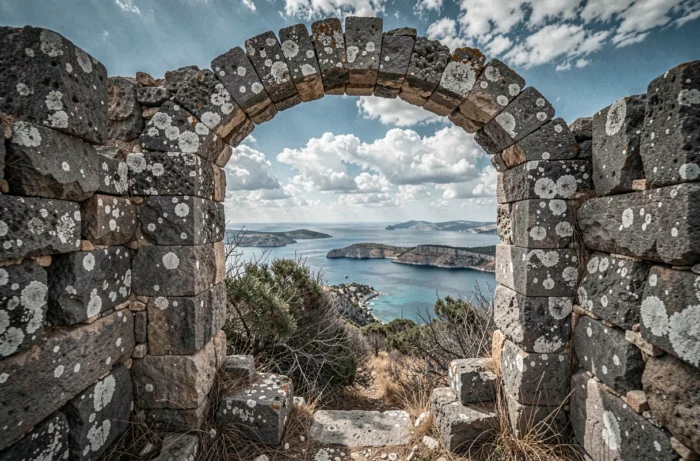
The Gramvoussa peninsula, which closes Balos Bay to the north, bears the ruins of a Venetian fortress built to control the maritime passage between Crete and the Peloponnese. After the fall of Crete under Ottoman rule, this bastion remained one of the last points of Venetian resistance in the Eastern Mediterranean.
In the early 19th century, during the Greek War of Independence, Cretan insurgents took refuge in the fortress. Cut off from regular supplies, some turned to piracy to survive, attacking merchant ships that sailed along the coast. The myths surrounding Balos Beach find one of their most tangible roots here: tales of treasures buried in the caves of Gramvoussa still circulate in the Kissamos region.
The wrecks visible in shallow waters off the island fuel these stories. No systematic archaeological excavation has confirmed the presence of pirate loot, but local divers’ field reports regularly mention remnants of wood and metal beneath the waters of the strait.
Minoan Legends and Mythological Traces in Western Crete
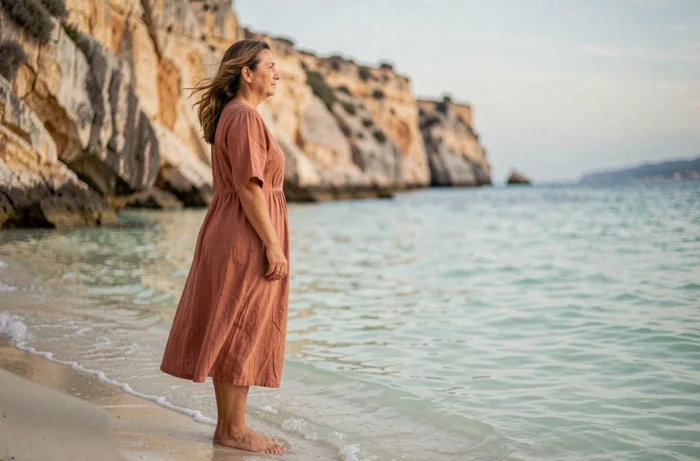
Crete is inseparable from Minoan civilization and its mythological extensions. King Minos, the Minotaur, the labyrinth of Knossos: these tales structure the imagination of the entire island. The western region, where Balos is located, remains somewhat removed from the major Minoan archaeological sites concentrated around Heraklion and Phaistos.
This absence of monumental remains has not prevented local oral tradition from linking the Tigani peninsula (the flat rock formation extending Balos) to older narratives. Tigani means “frying pan” in Greek, a reference to the flattened shape of the islet. Some residents of Kissamos associate this silhouette with a ship petrified by the anger of Poseidon, punishment inflicted on sailors who would have desecrated a coastal sanctuary.
The available data does not allow for precise dating of the origin of this legend. It shares recurring motifs with other Cretan tales of divine petrification, where the spectacular geology of the coastline serves as a backdrop for supernatural explanations.
Pink Waters of Balos and Popular Interpretations
The sand at Balos exhibits pink hues in some areas, a phenomenon attributed to the presence of crushed shell fragments. This coloration has generated its own narratives. One local version tells that the blood shed during battles between pirates and Ottoman soldiers permanently stained the sand.
The scientific explanation points to microorganisms and coral debris, but the overlay of the warrior narrative on a natural phenomenon illustrates how Balos accumulates narrative layers. The visitor literally walks on ground that has been reinterpreted by each era.
Balos Classified as Natura 2000: When Protection Reconfigures Legends
The lagoon of Balos is part of the Natura 2000 network, a European environmental protection framework. This classification has concrete consequences for site attendance, and thus for how visitors interact with its stories.
In the summer of 2026, the municipality of Kissamos proposed a time-slot access system with a limit of around 1,200 visitors over a three-hour period. This project, submitted to the Greek Ministry of Environment and Energy, includes several measures:
- An obligatory online booking platform, both for boat excursions and for access via the land path
- Real-time tracking of the number of people present in the lagoon, thanks to the synchronization of boat booking systems and access points
- A stated intention to “partially de-commercialize” the site to preserve its fragile ecosystem
This regulatory shift reconfigures the experience of Balos. A place whose aura partly relied on its wild and difficult-to-access character (the descent via the unpaved path remains challenging) could become a site with planned access, which alters the very perception of its “mystery.”
Traveler Tales and the Construction of the Balos Myth
The legends of Balos are not fixed in a distant past. They are constantly recomposing through the narratives of contemporary travelers. Travel blogs and social media have amplified certain motifs: the lagoon as a “Caribbean lost in Europe,” the “secret” beach even as it hosts thousands of visitors in high season.
The gap between the narrative of isolation and the reality of attendance creates a modern myth. Photos taken at dawn, before the arrival of excursion boats, maintain the illusion of a pristine place. This visual framing work extends, with digital means, the same dynamic as the oral legends of pirate treasures: selecting a fragment of reality and transforming it into a narrative.
The Kissamos region itself participates in this construction. Local guides willingly integrate the stories of Gramvoussa and Tigani into their tours, blending documented historical facts and oral traditions without always marking the boundary between the two.
Gramvoussa, Tigani, Balos: Three Names for the Same Territory of Stories
What makes Balos unique in the Cretan landscape is the geographical concentration of its narrative layers. Within a few square kilometers coexist a Venetian fortress, shipwrecks, a protected lagoon, and a geological formation interpreted by mythology. Few Mediterranean beaches can claim such a density of overlapping stories.
The implementation of a visitor quota could paradoxically enhance this aura. A place with restricted access gains symbolic value. The legends of Balos, whether they speak of pirates, Greek gods, or pink sand, will continue to feed on what the site refuses as much as on what it shows.