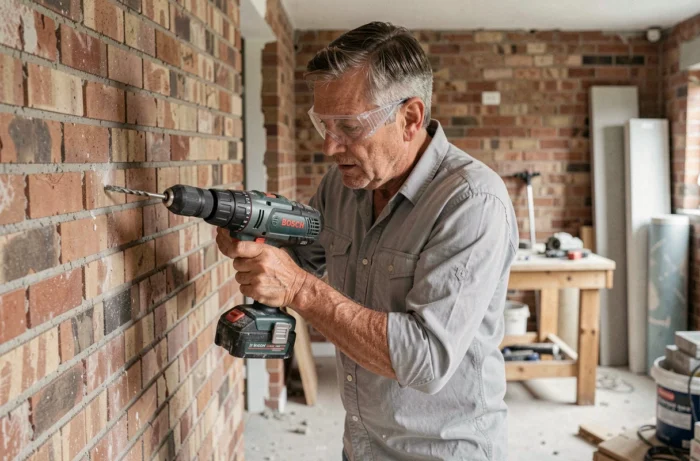
The Bosch CSB 500 RE is one of those corded hammer drills that can still be regularly found on online sales sites, despite a Bosch catalog that is now heavily pushing towards cordless. How does this model really hold up in 2025 for home use? This article assesses its technical characteristics against the current alternatives in the Bosch Home & Garden green range.
Bosch CSB 500 RE Corded Drill vs. Cordless Alternatives: The Power Dynamics
The positioning of the CSB 500 RE within the Bosch range deserves to be placed in a specific context. This model is now classified as a legacy tool in the Bosch green range, with no updates to its technical sheet for several years. Support is limited to spare parts.
Bosch is steering its strategy towards 18 V cordless platforms to cover exactly the uses that the CSB 500 RE fulfills: drilling in wood, metal, and lightweight concrete. The question is not just whether this drill works well, but whether it still represents a relevant purchase.
| Criterion | CSB 500 RE (corded) | Bosch 18 V Cordless Range (comparable use) |
|---|---|---|
| Power Source | Electric (cable) | 18 V lithium-ion battery |
| Chuck | Keyless, capacity up to 13 mm | Keyless, capacity varies by model |
| Speed Control | Yes, variable trigger | Yes, variable trigger + adjustable torque |
| Hammer Mode | Yes | Yes (on hammer models) |
| Range Evolution | No recent updates | Shared platform, regular updates |
| Parts Availability | Limited (some references out of stock) | Wide, active ecosystem |
This table highlights a rarely discussed point: the declining availability of spare parts. Several references for internal components of the CSB 500 RE are already reported as unavailable without replacement at Bosch parts distributors.
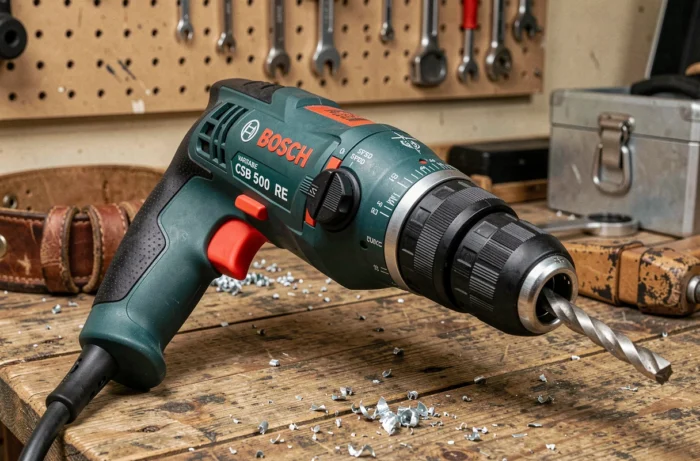
For those looking for a review of the Bosch CSB 500 RE drill before purchasing, this planned obsolescence of components weighs as much as the technical sheet itself.
Chuck and Speed Control Reliability: What User Feedback Indicates
The specifications on paper tell only part of the story. Feedback from users who have used the CSB/PSB 500 RE over several years reveals a consistent trend.
The drill generally receives positive evaluations at purchase and during the first few months. The power is sufficient for regular drilling in wood and soft materials. The keyless chuck makes bit changes easy.
However, the chuck and speed control show signs of weakness after a few years of use, even moderate use. Users report that the chuck loosens during drilling, a phenomenon documented on several French-speaking DIY forums. The speed control can also lose its smoothness over time.
- The keyless chuck tends to loosen under the impact of percussion, requiring manual tightening during work
- The plastic casing, while it protects well initially, ages unevenly depending on storage conditions
- The modest-length power cable limits the working radius and experiences mechanical stress at the entry point into the housing
These points do not indicate an isolated manufacturing defect. They reflect a design level suited for very occasional use, not for regular, even light, employment.
Concrete, Hardwood, Metal: The Concrete Limits of Percussion at This Power
The percussion function of the CSB 500 RE theoretically allows for drilling in concrete. In practice, this mechanical percussion quickly reaches its limits on reinforced concrete or dense materials.
For cellular concrete, hollow bricks, or concrete blocks, the drill fulfills its role. Drilling remains reasonably fast with an appropriate bit. In soft wood and thin metal, the results are acceptable for occasional home use.
As soon as you move to solid concrete or reinforced concrete, the mechanical percussion of this power range cannot compete with a pneumatic hammer. The tool heats up, progress slows drastically, and the risk of damaging the chuck increases. This is not a defect specific to the CSB 500 RE: all percussion drills in this category share this limitation.
The key point here concerns positioning. If your work regularly includes drilling into hard materials, a dedicated hammer drill (even an entry-level one) will be more suitable and more durable than a percussion drill pushed beyond its comfort zone.

Buying a Legacy Bosch Corded Drill: For Which User Profile
The CSB 500 RE retains an advantage that cordless models cannot match at the same price: constant power without battery management or charger. For a very occasional user who drills a few holes a year in wood or drywall, this argument remains valid.
The corded option also eliminates the issue of self-discharge and aging lithium-ion cells. A corded drill stored in a garage for two years starts up immediately. A cordless drill in the same conditions may require a battery replacement.
This usage profile is, however, becoming increasingly narrow. The Bosch 18 V ecosystem allows sharing a single battery among multiple tools (screwdriver, jigsaw, sander), which amortizes the initial extra cost. For someone considering acquiring other Bosch tools in the future, investing in the 18 V platform from the start is cheaper over time.
The CSB 500 RE remains a functional tool for simple and occasional tasks. Its technical specifications are not scandalous for its price segment. The real issue lies elsewhere: it is a product at the end of its cycle, with spare parts gradually disappearing and no prospect of evolution. A purchase today is a purchase with a limited lifespan, not due to initial quality, but due to the abandonment of manufacturer support.