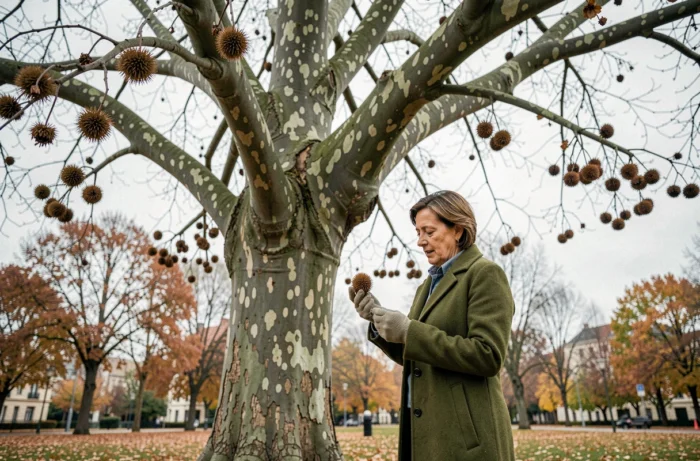
The plane tree mulberry (Morus kagayamae) and the common plane tree (Platanus acerifolia) share a lobed silhouette that fosters persistent confusion. Their fruits have nothing in common: the plane tree produces dry, inedible achenes, while the plane tree mulberry yields juicy, perfectly edible berries. Distinguishing between these two trees before planting avoids years of disappointment.
Tiger longhorn beetle and plane tree mulberry: a phytosanitary threat to consider in variety selection
Since 2023, several municipalities in Occitanie (Gard, Hérault) have issued alerts regarding Xylotrechus chinensis, an invasive beetle originating from Asia. This insect specifically targets plane tree mulberries and plane trees, causing rapid decline and eventual death of the tree.
In 2024, ANSES published a management recommendation mandating the chopping of affected trees into pieces smaller than 50 mm directly on-site, with transport to a waste disposal site and a mandatory chopping certificate. Open-air burning remains prohibited, with no exceptions possible.
This health risk significantly alters the sustainability calculation of a plane tree mulberry compared to other fruit trees. We recommend checking with the local FREDON to see if your municipality is in a monitoring zone before any planting. A plane tree mulberry planted in an area already affected by the tiger longhorn beetle represents a fragile investment, regardless of the quality of the specimen.
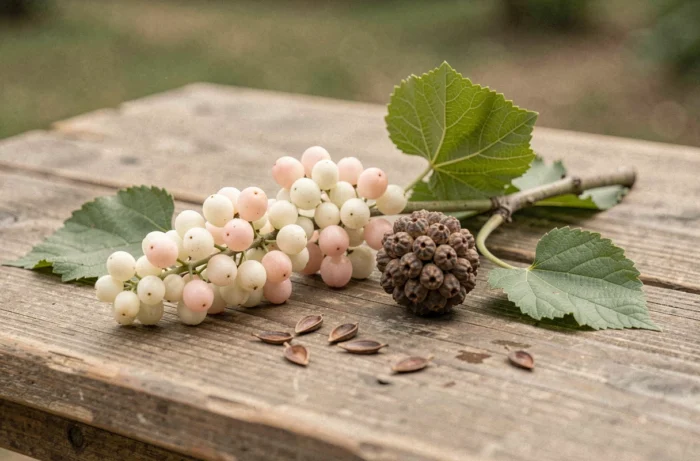
The confusion between the fruit of the plane tree and the plane tree mulberry remains the first trap for gardeners seeking an edible fruit tree. The common plane tree only produces spiky husks containing dry achenes, completely unfit for consumption. The plane tree mulberry, on the other hand, forms drupe clusters resembling blackberry fruits, which change from green to red and then to black when ripe.
Sterile or fruit-bearing plane tree mulberry: selection criteria in nurseries
The choice between sterile and fruit-bearing varieties determines the entire use of the tree. The sterile form, marketed as the parasol plane tree mulberry, produces no fruit. It is exclusively suitable for shading terraces, without the problem of crushed mulberry stains on light paving or near a pool.
The fruit-bearing form, however, requires a location where the drop of ripe fruits does not cause inconvenience. We observe that nurserymen do not always specify this point, and a specimen sold as “plane tree mulberry” without further mention is generally fruit-bearing.
Points to check before purchase
- The exact botanical name: Morus kagayamae (synonym Morus bombycis) for the plane tree mulberry, not to be confused with Morus alba (white mulberry) or Morus nigra (black mulberry), which are distinct species with different taste profiles
- The mention “sterile” or “fruitless” on the label, the only guarantee of absence of fruiting. In the absence of this mention, consider that the tree will produce mulberries
- The mode of propagation: a specimen grafted onto Morus alba offers better root compatibility in calcareous soil than a seedling
- The health condition of the trunk: check for the absence of emergence holes from wood-boring insects, particularly in the Mediterranean region where the tiger longhorn beetle is active
Soil, exposure, and care of the fruit-bearing plane tree mulberry
The plane tree mulberry tolerates most drained soils, including calcareous and dry soils in summer. It withstands prolonged drought periods once established, making it a suitable candidate for Mediterranean gardens without irrigation.
Full southern exposure enhances the taste quality of the mulberries. In semi-shaded conditions, fruiting decreases significantly, and the fruits remain more acidic. For fruit use, we recommend a complete clearing of the crown on the southern side.
Training pruning is done in winter, on bare wood. The plane tree mulberry responds very well to severe pruning, allowing it to be shaped as a parasol (cat head) or in a free form depending on the available space. Fruiting occurs on the wood of the year: regular winter pruning thus stimulates mulberry production rather than compromising it.
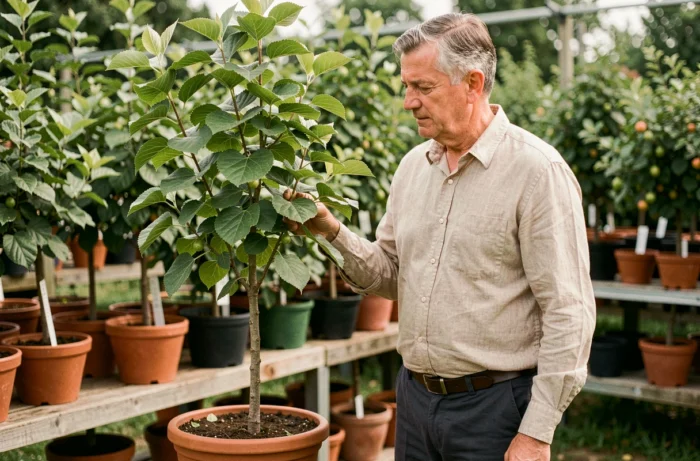
Harvesting mulberries from the plane tree mulberry: maturity and legal framework
Mulberries from the plane tree mulberry reach maturity between July and September depending on the climate. The ripe fruit detaches at the slightest touch and immediately stains hands and clothing. The most effective technique is to spread a net or sheet under the tree and shake the branches rather than picking fruit by fruit.
A black, soft, and slightly sticky fruit is ready to eat. A fruit that is still red will be acidic and astringent. The appropriate harvesting window lasts only a few days per cluster, necessitating frequent visits.
Regulations on foraging in France
On private land, any harvesting without the owner’s consent is considered theft. In public forests managed by the ONF, family foraging (not intended for sale) is tolerated up to 5 liters per person per day. This rule applies to both blackberry fruits and those from naturalized mulberries found in peri-urban areas.
The plane tree mulberry remains a private garden tree in the vast majority of cases. The question mainly arises for older specimens planted in communal alignments, whose fruits fall into public spaces.
Plane tree mulberry or black mulberry: which fruit tree to prioritize for taste
Morus nigra (black mulberry) produces sweeter and fleshier fruits than Morus kagayamae. If the primary goal is taste quality for jams, coulis, or fresh consumption, the black mulberry clearly wins. However, its growth is slower, its form less wide, and its foliage less dense for shading.
The plane tree mulberry offers a compromise between shading and fruiting. Its rapid growth, spread crown, and drought resistance make it more versatile in residential contexts. For a garden where the tree should also serve as a natural parasol above a terrace, it is the most coherent choice, provided it is planted outside the tiger longhorn beetle alert zone.
The common plane tree, on the other hand, only fits into this consideration by name. Its fruits are inedible, its adult size far exceeds that of a standard garden, and its pollen is a major allergen. Confusing the two trees leads to a fruiting dead end.